
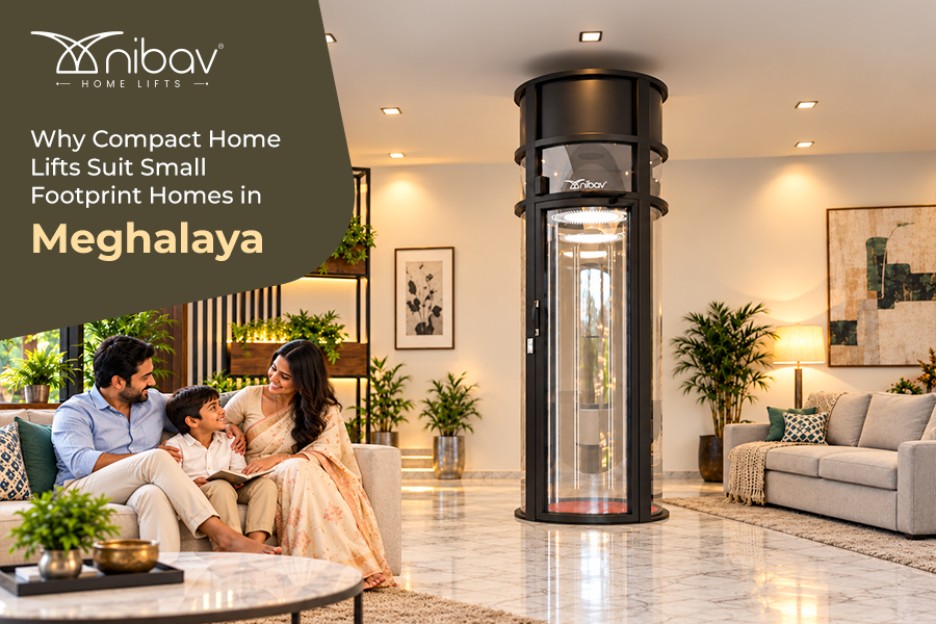
In Meghalaya, flat land is scarce to find. Whether you live in busy Shillong areas like Laitumkhrah and Malki, in Tura in the Garo Hills, or in Jowai in the Jaintia Hills, most homes are built on small or uneven plots. Since there is little land to build on, families build upwards. They add a second or third floor as the family grows or to rent out rooms.
As a result, many homes take up little ground space but have several floors and many stairs. Over time, these stairs become harder to climb for elderly people, those recovering from illness, and anyone carrying shopping bags or water upstairs. Compact home lifts are made for exactly these kinds of homes. This blog explains why they suit homes in Meghalaya and what families should consider before installing one.
How are Homes in Meghalaya Built?
Small Plots, Vertical Growth
Hill towns don’t have much room to spread out. Plots tend to be narrow or irregular, and setbacks, slopes and access roads further limit the buildable area. Building upward is often the only way to get more space, which means more floors and steeper internal staircases.
Mixed Construction Styles
Meghalaya has a mix of building styles, from traditional Assam-type houses with timber frames and sloping tin roofs to newer reinforced concrete buildings. Older homes may have lighter structures that cannot easily carry heavy additions, while newer homes may have tight internal layouts with little spare space.
Shared Family Homes
Many households have several generations living in the same building, often on separate floors. A lift helps connect these levels so family members can move between them easily.
Why Compact Lifts Make Sense
1. They Fit Where Traditional Lifts Cannot
A conventional elevator usually needs a concrete shaft, a pit below the ground floor and sometimes a machine room. In a house with a small footprint, finding space for all of this can mean giving up a room. Compact home lifts need only a small area on each floor and can often fit beside a staircase, in a corner or in a stairwell void.
2. Less Load on the Structure
Self-supporting compact lifts stand on their own frame rather than depending heavily on the building’s walls. This matters in older homes with lighter construction, where adding a heavy concrete shaft may not be practical.
3. Little or No Digging
Excavating a pit on a hillside plot can be tricky. Rock, slope stability and drainage all complicate the work. Many compact lifts need little or no pit, which reduces both cost and risk.
4. Easier Transport and Installation
Narrow, winding hill roads can make it difficult to bring large equipment and materials to a site. Compact lifts typically arrive in modular parts that are easier to carry to homes on steep or narrow lanes.
5. Quicker, Cleaner Work
Less civil work means less dust, noise and disruption. This is especially helpful for families who will keep living in the house during installation.
How to Plan for Meghalaya’s Climate?
Heavy Rain and Constant Moisture
Meghalaya is one of the wettest places on earth. Sohra (Cherrapunji) and Mawsynram are famous for their rainfall, and even Shillong sees long, wet monsoons. High moisture can affect metal parts, electronics and finishes. Ask suppliers about corrosion-resistant materials, how electrical parts are protected from damp and what maintenance is recommended in very humid conditions.
Cool Temperatures and Fog
Shillong’s cool climate and frequent fog mean condensation can collect on surfaces. Good ventilation around the lift area and in the cabin helps prevent moisture problems.
Earthquake Safety
The whole of Northeast India lies in a high seismic zone, and Shillong itself was badly damaged in the great earthquake of 1897. Any lift and structural changes should be checked by a qualified structural engineer and installed according to applicable safety standards. A lightweight lift that adds little load to the building is a sensible choice in this region.
Power Interruptions
Hill areas can experience power cuts, especially during storms. Ask how the lift behaves during an outage and whether it can safely bring passengers to the nearest floor.
How to Choose the Right Compact Lift?
When comparing options for a small-footprint home, check:
- Exact footprint:Measure the space on every floor and compare it with the lift’s requirements.
- Headroom:Check how much clearance is needed above the top stop, especially under sloping roofs.
- Number of stops:Make sure it can serve every floor you need, including the terrace.
- Cabin capacity:Decide whether one or two people are enough, or whether a wheelchair needs to fit.
- Power requirements:Check whether it runs on your existing household supply.
- Service support:Confirm that technicians can reach your town quickly.
A Real-time Example
Consider a family in Laitumkhrah living in a three-storey house on a narrow plot. The ground floor has a small shop and storage; the family lives on the first floor, and the grandparents have rooms on the second floor, along with a sunny terrace used for drying clothes. The staircase is steep and narrow, and the grandmother had started avoiding the terrace and even the family dining area downstairs.
The family wanted a lift but assumed there was no room. After a site visit, they found that a compact lift could fit in a corner beside the staircase landing on each floor. Installation needed only small openings in the floor slabs and no digging into the rocky ground. Now the grandparents join family meals every day and spend time on the terrace when the sun comes out.
Conclusion
Meghalaya’s homes make the most of limited land by building upward, but that leaves many families with steep staircases and multiple floors to manage. Compact home lifts fit small footprints, place less load on the structure, need little digging and are easier to bring up hill roads, which makes them well suited to the region.
With careful planning for heavy rain, humidity, earthquake safety and power cuts, a compact lift can make daily life far easier. Families seeking options can explore compact home lifts in Meghalaya from Nibav Lifts, designed for independent homes with limited space. A site assessment can help you understand what will fit in your home.